Wednesday, March 13, 2013

Wembley optician to fly to Ethiopia on charity mission - News - Kilburn Times

Wembley optician to fly to Ethiopia on charity mission

Ananda Sena is undertaking a two-weeek charity trip to EthiopiaAnanda Sena is undertaking a two-weeek charity trip to Ethiopia

A Wembley optician will be flying out to Ethiopia next week on a charity mission to help poor villagers with their sight problems.
Ananda Sena, an optometrist at Specsavers in Wembley High Road, will screen the eyes of people living in Hawassa and fit them with donated glasses if needed.
The project is part of Vision Aid Overseas, an international charity dedicated to transforming access to eyecare in developing countries.
Mr Sena will be among a team of three volunteer eyecare professionals that will work alongside doctors to bring the vital service to the village.
He said: “Having worked in optics for a few years I decided that I wanted to use my skills to help developing countries.
“We take eyecare for granted in the UK as we have opticians on every high street but it’s amazing how much of a difference a pair of glasses can make to someone’s quality of life.”
Anyone wishing to make a donation to Mr Sena’s cause can do so by visiting his Just Giving page http://www.justgiving.com/ananda-sena.
For more information about Specsavers in Wembley se

Sunday, January 13, 2013

Ethiopia to Push Health Scorecard for African Continent

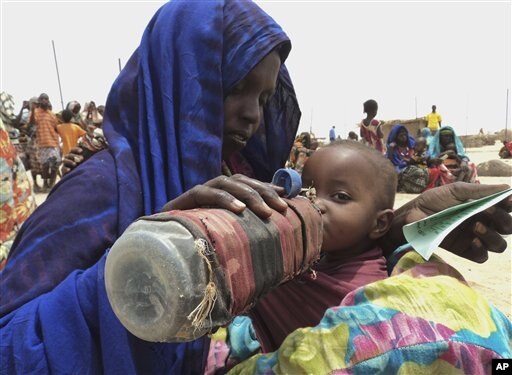
A mother quenches her malnourished child's thirst while waiting for food handouts at a health center in drought-stricken remote Somali region of Ethiopia, July 9, 2011.
TEXT SIZE 
Marthe Van Der Wolf

Sunday, December 16, 2012

It's arrogant to say anorexia is a personal choice rather than a mental illness

The advertising campaign featuring Isabelle Caro.
The advertising campaign featuring French actress and anorexia sufferer Isabelle Caro. Photograph: Getty Images
In November 2010, almost exactly two years ago today, a 28-year-old French model called Isabelle Caro died from complications arising from anorexia. A few years before, in 2007, she had risen to increased prominence after appearing in an advertising campaign to raise awareness of eating disorders within her field. Stick-thin, with vertebrae clearly on show, she stared straight out of the billboards that lined Italian cities and were later (controversially) banned. The image was undoubtedly shocking; some even found it outright traumatic. Its accompanying message - "No Anorexia" - made a clear statement about the fashion industry when it was pushed out to the Italian public during fashion week.
If you’re looking for an "anorexic statement", then Caro’s is as close as you can get. She suffered from the disease from early adolescence, and she spoke about being in its grips as a personal struggle. She talked publicly of how she wished to be rid of the crushing mental illness, right up until the two months before her death. The "No Anorexia" campaign was about drawing attention to the downright ugliness of a body destroyed by an anorexic life, the ironic lack of glamour in an illness that pervaded industries priding themselves on allure and desirability. And these reasons are why, for many, Rachel Cusk’srecent article on anorexia in this magazine hurt so much.
Does every woman’s body make a statement? Cusk thinks it does. She claims that the anorexic state "returns the woman to the universality of a child", a pre-pubescent state wherein she doesn’t have to think about menstruation or lactation or childbirth or sex. She paints the sufferer of anorexia as a narcissistic martyr of the modern age, obsessed with her image, privileged enough to impose an illness upon herself, sitting "screaming about a spoonful of peas" while other people just get on with the practicalities. Needless to say, sufferers and former sufferers of the disease, as well as their loved ones, didn’t take kindly to this reductive and convenient analysis.
Why is such an analysis convenient? Precisely because mental illness is infuriatingly inconvenient in its individuality and nuance. Treatments and causes are varied and often inexplicable. Personalities are, by their nature, all very different. By positing an "anorexic type", Cusk makes the problem of anorexia wonderfully simple: it’s just a "sickness of the modern age" manifested in a certain type of defective personality. If they’d stop indulging themselves for one pea-eating second, or experienced some real type of hardship, then they’d snap out of it once and for all, right? If Isabelle Caro had really sat down and thought about it, then she could have saved herself the massive setback of dying during her anti-anorexia campaign.
Even aside from all of this offensive hypothesising, it’s strange enough that Cusk maintains throughout her article the idea that women speak with their bodies, but men don’t. She talks about periods and childbirth as physical states to escape from as if men are beings wholly removed from such concerns (because blood is a problem, but semen is supposedly totally cool.) And feminists have fought for a long time to remove the basic assumption that women are "naturally decorative", "speaking" through their bodies alone, expressing their complaints about society by getting thinner and a little bit childlike, while men are naturally intellectual, objective, and altogether more adult. We suppose that the last fifty years of feminist thought have passed Cusk by, as well as the fact that male sufferers of anorexia exist, unfortunately, in substantial numbers. 
Indeed, Cusk appears to have done little research about the illness, instead relying on verbose rhetoric. At one point in her dense treatise, she implies that anorexics of craving visibility. The "anorexic statement", as she so coldly calls it, seeks attention. And yet, so many sufferers speak of wanting to disappear. This does not compute. Cusk speaks with the authoritative and detached voice of a scientist, but she is no scientist. Her overwrought prose serves to raise her essay up to the status of literature, concealing her crass generalisations beneath "sophisticated prose". And yet, it is lacking in any of the perception or insight associated with that term. Her continual use of "the anorexic" throughout the essay makes her seem emotionless and removed, and she seems to forget that this is a disease that affects real people, not simply medical cases whose motives must be dissected and speculated upon in florid prose.
Anorexia is a complex, awful, terrifying disease, the causes for which are a constant topic for research by medical professionals. Its causes do not fit neatly into a single tick-box, and thus lumping all its sufferers together into one group is supremely unhelpful. As a commenter who had reached recovery noted beneath the original article, "no book or article that I read has ever explained how I got there". To presume a statement on the part of another belies supreme arrogance. Cusk has projected that "statement" onto women and girls who are suffering from a life-threatening illness, women and girls whose friends and family may be reading Cusk’s words in between hospital visits. That she should imply that mental illness is a choice is verging on the unforgiveable as far as anyone who’s ever suffered one is concerned.
At one point in the piece, Rachel Cusk refers to the male gaze. She blames what she calls "the preponderance of male values", and yet there she is, judging these women’s bodies, projecting her agenda, her pseudo-psychoanalysis onto them. In other words, it is not their bodies speaking. It is not their story. Isobel Caro’s "anorexic statement" was just that because she, the sufferer made it, and no one else. In light of this, we should be aware that the only statement that Cusk is making in her article is applies to herself.

Tuesday, October 30, 2012

MSF Blogs: Overcoming Ethiopia's Natural Hurdles | Doctors Without Borders

MSF Blogs: Overcoming Ethiopia's Natural Hurdles

OCTOBER 29, 2012

Ethiopia 2012 © Kate Chapman
The muddy road near the clinic in Adura.


MSF Nurse Kate Chapman
Kate Chapman is an Australian nurse with an emergency/trauma background. Here, she blogs fromEthiopia, her second mission with Doctors without Borders/Médecins Sans Frontières (MSF). Read Kate's MSF Blog here.
Well, it’s Sunday again. It’s been another long, frustrating, and concerning week.
On Wednesday, the river had risen so much that the area where we land the boat in town had broken its banks and flooded half the town. This left our only landing point around 800 meters from the road on the main dock, wedged between the many huge open-top steel cargo boats being loaded with contraband destined for South Sudan.
The clinic in Adura had been busy with over 150 patients. On the way back we had one patient for transfer in the car, an old lady with TB. We came across some men carrying a very unwell-looking man. We stopped, found him to be critical, packed him in the car, and made our way back to Mattar.
I called ahead to our base and asked them to send the boat with a stretcher and to meet us on the road. Of course no one was there when we arrived, so leaving the patients by the car we carried the heavy boxes of drugs and equipment to town, meandering through the heavily bogged path leading to the river. This is very difficult as just walking without carrying anything is a challenge in itself in the treacherously slippery Mattar mud. I am twice as good at not falling over compared to how I was at the beginning of the mission, but compared to the sure-footed team I’m still a joke!
Our boat was wedged between two huge cargo boats and the river was chock-a-block full of lilies slowly creeping from upstream Adura, headed for the big Baro River where the current will take them to Sudan. We literally had to pull our boat along by hand using the cargos to get out. I sent the team back with the gear asking them to drop it off then come back with a stretcher for the patients. I went back to the patients and waited. Half an hour went by before the logistician turned up with the stretcher, but he said the motor was playing up on the boat and he couldn’t get in near town so he was going back alone and the other boat would pick us up. I, together with some locals and caretakers, brought the patients down from the road to town under the shade of a tree. Another hour went by with no one turning up so I called base again and was told they had left ages ago.
The town riverfront was boxed in by cargo boats being loaded. The river was so full of lily plants that it looked like an iridescent green field you could walk across. After pacing up and down the bank for some time I spotted our boat. It was slowly making its way through the jungle of plants. There was nowhere to dock and after trying in vain with an army guy to push the cargos to make enough room, our driver finally pulled up at the end of the dock behind the cargos.
We carried the patient on the stretcher, the old lady and her belongings, and some other bits through the bustling hive of dockside activity, climbed into one laden cargo boat, walked across the supplies packed beneath the tarpaulin, climbed into a second cargo boat, and walked the length of it atop their cargo to the end where the owners and packers helped us lift and pass both the stretcher and the old woman and supplies to our boat. I then found out why it took so long to come back and get us. The river was literally choked with lilies and clumps of grass as far as the eye could see. We had to break our way through, separating the lilies with a stick. It took around half an hour to travel the one kilometer back to the compound. This river is a truly amazing endless source of change.
After getting back and taking the patients to the health center I did my computer work, unpacked the metal boxes, and repacked the plastic ones in preparation of Jikow on Thursday. I then went to bed as a sore throat, runny nose, and earache had been plaguing me since Monday. About half an hour later, our program coordinator called me with some bad news! Our second boat with the 40 horsepower motor was stuffed! Kaput! Finito! Totally knackered! So that meant no Jikow, no Nasir, no boat travel other than from base to town.
I wasn’t too upset about not spending six to eight hours in the boat while I was feeling like s**t, but more importantly the nutrition kids would be without their therapeutic food and the leprosy, tuberculosis, and HIV patients would be without their medication, which means they will need reassessment and blood levels taken in Gambella before restarting treatment. This is a nightmare, as anything to do with movements takes weeks of frustration to organize, especially for non-urgent patients, so many—like our previous leprosy man—will relapse before recommencing treatment.
The atmosphere at home has changed with the reduction of people and now it’s a bit more relaxed. The bugs are horrific and have plagued our everything for the last few weeks. If you pour a coffee you will get earwigs from both the kettle and the sugar. Small lice-like bugs the size of a thumb nail have invaded with force and are constantly crawling, biting, and getting into places better left undescribed! Whenever you walk through a doorway the small tick-like bugs fly straight into your face, up your nose, and any other orifice they can enter. The trick is to close your eyes and exhale as you enter or leave. The stink bugs, small, black, crispy, biting bugs that stink like rotten meat are constantly in our hair (lucky Matthieu) or crawling on us. When you brush them off or touch them they dispel their odor tenfold. Not to mention they taste just like they smell! Last night when I was cooking dinner, they were so thick in the kitchen that Petra stood behind me flapping a towel, trying to create enough air to keep them out of the pan!
With the bugs also come the swallows. A fantastic frenzy of flying acrobats that swoop and soar in spasmodic, unpredictable waves of excitement. I think they are chasing bugs, but I honestly can’t see. Anyway it’s a spectacle to see.
With the rising river, the huge Schelle (Nile perch) 20–100 kilos in weight have arrived, not to mention the 20–30 kilo tiger fish with teeth so sharp and long they could take a finger off in a single snap, probably an arm with one bite and a quick shake!
Yesterday afternoon I sat in the boat by our dock having a little R&R, smoking, soothing my burning throat with a cold coke and dangling a line just by the side of our cargo boat. I got a bite straight away, lost my line with the weight of it, caught a small one (twp foot) then lost my line again. I can wind them in to the edge of the boat but one shake of the head snaps my light 15 pound line so I actually get to see what I’m losing! Anyway, I caught a few small ones but without a heavy line and steel trace I won’t be landing any of these monsters! Imagine catching a fish as big as me!!! I think I’ll try and make a gaff of some description today! Anyway, our freezer is full of some of the nicest fish I’ve ever eaten. Gone are the days of pasta and tomato sauce! Its fried fish, baked fish, fish soup, fish stew, and with my new soup supply, fish mornay!

Saturday, August 18, 2012

A Jewish Medical Giant in Ethiopia | Jewish & Israel News Algemeiner.com

AUGUST 17, 2012 1:52 PM 4 COMMENTS

JDC's Dr. Rick Hodes treats a child in Ethiopia. Photo: Richard Lord/JDC.
When a planeload of secular Israelis landed in Addis Abba shortly before Pesach last spring, they were greeted by a small Ethiopian boy holding aloft a hand-made sign reading: “Ask me about a Passover seder.”
The man behind the sign was Dr. Rick Hodes, medical director of the American Jewish Joint Distribution Committee (JDC) in Ethiopia. His accomplishments in saving lives are legendary and have been chronicled in numerous articles and books. Moreover, Dr. Rick, as he is widely known, was the subject of an HBO documentary, “Making the Crooked Straight,” and other films.
To understand why an American doctor would want to motivate perfect strangers to participate in his seder, one needs to understand what makes Dr. Rick tick.
Richard Hodes was born into a middle-class Jewish family in Syosset, Long Island.
He graduated from Middlebury College with a degree in geography. When his father pointed out the career limitations for geographers, Hodes enrolled in medical school at the University of Rochester and subsequently trained in internal medicine at Johns Hopkins University. He first went to Ethiopia during the famine of 1984 and returned in 1985 as a Fulbright Professor, teaching medicine at Addis Ababa University. He was hired by JDC in 1990.

Dr. Rick Hodes treats a baby in Ethiopia. Photo: Richard Lord/JDC.
As JDC’s medical director, Hodes is responsible for taking care of Ethiopian immigrants to Israel between the time the Israeli authorities have selected them and their departure. His clinic staff consists of himself plus one Ethiopian physician and several nurses and aides. At any given time, he looks after more than 4,000 people.
“We need to keep them healthy and take care of whatever comes up,” Hodes says in an interview with JNS.org.
In addition to his work for JDC, Hodes’s clinic takes care of seriously ill, often destitute, Ethiopians, and it is for them that he has performed countless medical miracles, especially in the area of cancer and diseases of the spine and heart. A number of these are described in great detail on his website: www.rickhodes.org.
Hodes, who is single, lives in a modest house in Addis Ababa with several of his adopted Ethiopian children, all former patients. When we met him, he was accompanied by 18- year-old Dejene Hodes, one of his adopted sons. He had tuberculosis of the spine when he was adopted from Mother Teresa’s Mission. Hodes sent him to Dallas, Texas, for back surgery and Dejene remained there for two years. He is now perfectly fit, recently graduated from the Yavneh Jewish Day School, and plans to study engineering in college.

JDC's Dr. Rick Hodes treats a child in Ethiopia. Photo: Richard Lord/JDC.
Hodes is an observant Jew who says he is “anchored” by the Jewish calendar. He prays and puts on tefillin virtually every morning, keeps Shabbat and celebrates all holy days and festivals. When asked why he has devoted his life to the people of Ethiopia, he replied, “We, of course, have to look out for other Jews, but we absolutely must help the rest of the world. After all, we are commanded to perform ‘tikkun olam.’”
JDC began its operations in Ethiopia as part of Prime Minister Golda Meir’s “African Strategy” and is recognized as an NGO by the Government of Ethiopia. In addition to operating its clinic, JDC builds schools-20 of which have so far been completed outside the capital- digs wells to supply fresh water, and funds scholarships to enable (mostly Christian and Muslim) girls to obtain higher education. When asked “Why only girls?” Hodes replied that “the only way for the world to get better is to make sure girls are educated.”
According to Hodes, the average Ethiopian does not quite understand Judaism and thinks it is some branch of Christianity. Ethiopian Jews recognized as such by the Sephardic Chief Rabbi of Israel in the early 1970s know they are Jews and are different from other people religiously. Relations between the government of Ethiopia and Israel are amicable, and Hodes believes the average Ethiopian “is really pro-Israel.”
In western eyes, Hodes, even at 5-foot-3 and 123 pounds, is a giant. But when it comes to treating ordinary Ethiopians, he says he competes “with witch doctors.”
“I’m not their first choice—local healers are!” he says.

Thursday, August 16, 2012

Surge of doctors to strengthen health system says the Ethiopian regime

ADDIS ABABA, 14 August 2012 (IRIN) - Ethiopia is preparing for a flood of medical doctors within "three to four years", an influx meant to save a public health system that has been losing doctors and specialists to internal and external migration. 

"We are now implementing strategies that intend to increase the current below-World Health Organization [WHO] standard number of medical doctors and retaining them in public hospitals," Tedros Adhanom, Ethiopia's minister of health, told IRIN. 

"We have now reached an enrolment rate of more than 3,100," he said. The rate of enrolment in the country's medical schools has increased tenfold from 2005, when it was below 300. 

"In the next two, three years, it could go to six and eight thousand," said the minister, adding that once these students start to graduate, the problem regarding shortage of physicians in the country "will [have] considerably stabilized". 

While WHO recommends countries have a minimum of one doctor per 10,000 people, Ethiopia has fewer than a fifth of that ratio, compared to a regional average of 2.2 physicians per 10,000 people. 

"We have not [supplied] enough doctors despite the high demand," Tedros told IRIN. 

A draft of the country's Human Resource for Health Strategic Plan shows an intended increase in the number of physicians to 1 per 5,000 people by 2020. The plan seems on course, with a report presented to parliament in May revealing 2,628 students had been enrolled in 22 universities over the previous nine months. Currently fewer than 200 doctors graduate annually. 

But once the new students start to graduate, "We can succeed in easing the problem significantly within three to four years," the minister said. "Afterwards, we can also have more doctors that specialize in several sub-health fields." 

Questions over quality 

With the strong emphasis on health personnel numbers, experts have expressed concerns about the quality of medical education available. 

"Of course, whenever emphasis is given to numbers, quality is compromised," said Milliard Derebew, a medical professor at Addis Ababa University. "Due attention should be given to quality as well," he said. 

Read more
 Still too many deaths in childbirth
 New programme boosts village health service delivery
 Ten countries desperately seeking doctors
 Plugging the health worker brain drain
Tedros also admitted quality is a concern. "We go [for] high speed and high volume, and keeping the quality could be a problem", though it is one that "should be addressed soon". He said the country would look to others for support in terms of funding and experience. 

Through the Medical Education Partnership Initiative (MEPI), the US is supporting Ethiopia's efforts to improve the quality of medical training. 

Milliard said medical teachers at Addis Ababa University receive incentives to they take additional classes. The initiative has improved the medical school's ratio of books-to-students, from one book per 24 students to one per three. 

"Besides [this], we are networking with known US universities through video conferencing so that the students learn from experience of others," he said. 

Focus on retention 

Challenges also remain in retaining doctors prone to migration. In 2006-2007, 37 percent of the country's public-sector physicians worked in Addis Ababa, which was only home to less than 4 percent of the population. 

"The remaining available physicians to the public sector serve the rest of the regions but [are] largely working in major cities," says the government's draft Human Resource for Health Strategic Plan. 

One study found that the country faces "a mass exodus of physicians," caused by low salary, insufficient supply of drugs, lack of professional resources and poor management. "Low quality of life in Ethiopia and political repression were found to be the most significant exogenous push factors of migration," the study said. 

Ethiopia has been able to increase the number of lower-level healthcare staff, such as health extension workers, helping to bridge the human resource gap at the village level. But in the long run, the ministry said, the present flooding strategy could be the way to boost the public health system. 


Photo: DFID
Child receives her measles vaccination, in Ethiopia's Merawi province
"If you can train in big numbers," said Tedros, the minister of health, "even if you lose some through brain drain, it may not be that significant. That's why we believe brain-drain is not the source. It's the mismatch between the demand and supply which is the source of the problem. On the other hand, you should also do something to retain the people that we train. 

"But whatever you use to retain should [be] based on what you can offer," Tedros continued. "For instance, you can't compete with developed countries in paying high the salaries. You can't compete with them by using the same approach," he said. 

Medical training is expensive, estimated to cost the country an average US$22,745 per student. Doctors are required to serve in public hospitals for some time before going into private practice in different countries. 

"Right now we are introducing financial and non-financial incentives to keep them," Tedros continued. "Apart from various incentives that regional governments give, the retention strategy includes lowering the fixed number of years that doctors should serve in rural health facilities and installing private wings in public hospitals," he said. 

Accordingly, the government expects graduate medical doctors to serve in rural public hospitals for a minimum of one year, while the service period in public hospitals in major and regional cities might reach up to five years. While in those hospitals, doctors can receive additional financial benefits from private wings set up in public hospitals. 

"We have private wing, for instance, that started in Ethiopia [where doctors can] work off-hours and weekends, and they get additional financial benefits," said the minister. "I don't think they would go anywhere because [the income is] not really as high as they would get if they migrate but it's good enough to sustain their life here, and they prefer to stay here with the additional funding they already generating themselves." 

Ethiopia currently has no alternative but to train physicians in large numbers, a strategy that has been applied in parts of Asia, said Kebba Omar Jaiteh, a senior WHO expert. "We have seen this trend in India and other Asian countries. When they start training at the beginning, people start moving, but they reach a saturation point whereby…people no longer want to go because the country has improved economic-wise and social-wise. Until that time comes, we need to keep on training in order to serve the people."